Das NarrenschiffLX
Я каши дурней не забыл,Как в зеркале себе стал мил:Ганс Ослоух мне братом был.
Des narren bry / ich nye vergaßDo mir gefiel das spiegel glaßHans esels or / min bruoder was
We haue ouercome the malyce and enuyOf suche as agaynst our Nauy did conspyreWherfore I shall my folys call quycklyThat they my Shyp may aparayle and atyreDrawe nere ye Folys whiche syttynge by the fyreLoke ay in a glasse to se your countenaunceAnd in your owne dedis haue all your hole pleasaunce
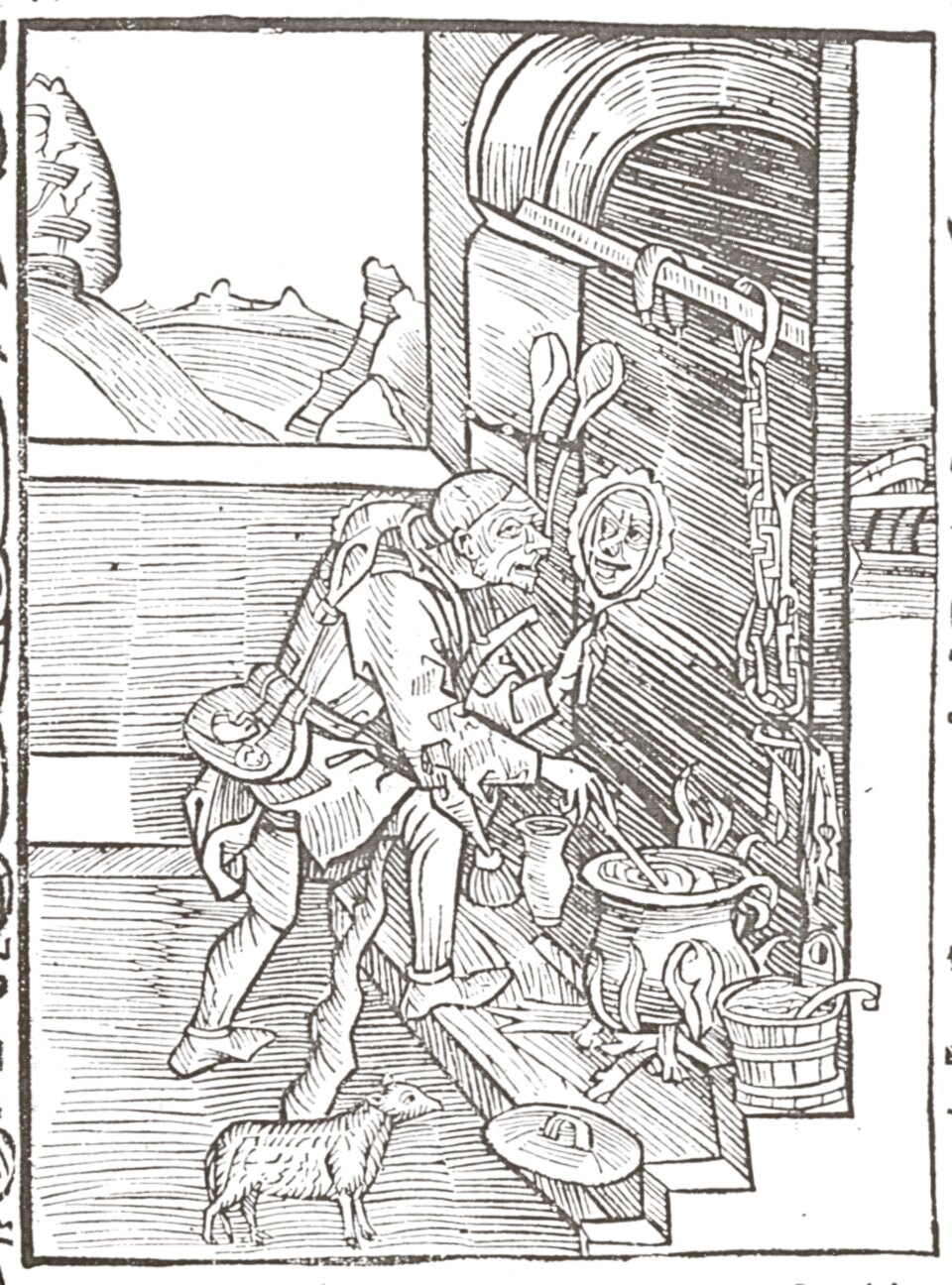
Of folys that stande so well in their owne conceyt that they thinke none so wyse, stronge, fayre, nor eloquent, as they ar themself
О самолюбованииOf Self-Complacency
Jm selbst wolgefallen❦
LXО самолюбованииOf Self-Complacency
Мешает кашу дураков,
Кто мнит: умнее всех голов,
И сам себе лишь только мил:
Всё в зеркало б глаза вперил,
А не смекнёт он всё равно,
Что дурня кажет лишь оно.
Но если б клятву дать пришлось,
Кто мудр, красив, — зайди вопрос,
Он мнит: один я в мире сем,
И равных нет мне здесь совсем.
И поклянётся: нет изъяна;
Что сам творит — ему желанно.
Он с зеркалом — в любом пути:
Сиди, лежи, скачи, иди.
Так кесарь поступал Отон:
И в битву зеркало брал он,
И щёки дважды в день скоблил,
И молоком ослиц их мыл.
То дело бабье искони:
Без зеркала никак они;
Пока приладят свой покров,
Нарядятся — год был таков.
Кто в нрав свой, в вид и труд влюблён,
Мартышка Гейдельберга он.
Пигмалиону люб был свой
Кумир — сдурел он, сам не свой.
Когда б Нарцисс не зрел в ручей,
Он жил бы много долгих дней.
Иной всё в зеркало глядит,
А не пригож в нём всё же вид.
Кто столь овечьи глуп умом,
Не терпит и упрёков в том:
Идёт своею колеёй
И к разуму он — ни ногой.
Der ruert jm wol den narren bry
Wer waenet das er witzig sy
Vnd gefelt alleyn jm selber woll
Inn spiegel sicht er yemertol
Vnd kan doch nit gemercken das
Das er eyn narren sicht jm glaß
Doch wann er schweren solt ein eyt
Vnd man von wiß vnd hüpschen seyt
So meint er doch er wers alleyn
Man find sins glich vff erden keyn
Vnd schwuer ouch / jm gebrest gantz nüt
Syn duon vnd lon / gfelt jm allzyt
Den spiegel er nit von jm latt
Er sytz / lyg / ritt / gang / wo er statt /
Glich als der keyser Otto dett
Der jn dem stritt eyn spiegel hett
Vnd schar all tag syn backen zwilch
Vnd wuosch sie dann mit esels milch
Das ist ein wibertaeding guot
Keyn on den spiegel ettwas duot
Ee sie sich schleygeren recht dar vor
Vnd mutzen / gat wol vß eyn jor
Wem so gefelt wiß / gstalt / vnd werck
Das ist der aff von Heydelberck
Pygmalion gfiel syn eigen bild
Des wart er jnn narrheyt gantz wild
Hett sich Narcissus gspieglet nit
Er hett gelebt noch lange zyt
Manches sicht staets den spiegel an
Sieht doch nüt hüpsches dar jnn stan
Wer also ist ein narrecht schoff
Der lidt ouch nit das man jn stroff
Jo gatt er jnn sym wesen hyn
Vnd wil mit gwalt / nit witzig syn
Vnto my shyp I call hym to be Coke
The mete to dresse to other Folys echone
Whiche in his myrrour doth alway gase and loke
Whan he may get hym vnto a place alone
And though of colour and beaute he haue none
Yet thynketh he hym self fayre and right plesant
And wyse: thoughe that he be mad and ignorant
In his owne dedys is onely his delyte
In his owne conceyte thynkynge hymself right wyse
And fayre, thoughe he be yelowe as kyte
Is of hir fete: yet doth he styll deuyse
His vayne myrrour: that onely is his gyse
And thoughe he beholde hym self of lothly shape
He wyll it nat byleue, but in his glasse doth gape.
Though for his foly all men myght hym repreue
And that he se it before hym openly
Within his glasse: he wyll it nat byleue
But strongly it defende and eke deny
He seyth nat his erys longe and hye
Whiche stande vpon his folysshe hode behynde
His lewde conceyt thus makyth hym starke blynde
Whan people comon of men of hye prudence
Or of hye beauty, and strength if men doth tell
If one suche fole were there in the presence
He swere durst boldly and that on the gospell
That he onely all other dyd excell
And that to gyue councell good and profytable
Were none in the worldly vnto hym comparable
These folys bost them selfe of theyr wysdome
And thynke them selfe to haue preemynence
Aboue all other that ar in christendome.
In gyftis of grace as beautye and scyence
Of strength, gode maners, vertue, and eloquence
But thoughe they stande in theyr owne conceytis
Nought is saue foly within theyr folysshe patis
And thoughe theyr face and vysage stande awry
And all to reuylde, theyr mouth standynge asyde
Within theyr myrrour the same can they nat spye
But in theyr foly contynually abyde
And whether that they ar styll outher go or ryde
Labour or be ydyll, they gase styll in theyr glasse
Yet wyll they nat byleue to haue erys lyke an Asse.
Oft whan these folys lye in theyr bed vpright
With tawny loke or els theyr botyll nose
They haue theyr myrrour alway in theyr syght
The vayne glasse (of theyr beautye) to apose
And whan suche a fole into the kechyn gose
To stere the pot, there whether he syt or stande
The glasse alway is in the other hande
Whan he a whyle his glas hath loken than
If one examynyd hym of his beautye
He boldly durst swere both by god and man
That nought were in hym whiche myght repreuyd be
But all goodnes, fayre shape, and loke of grauyte
And that his gere gayly vpon his backe doth syt
He hardly is wyse: if he had any wyt.
I wryten fynde that great inconuenyence
As losse, contempt and occasyon of pryde
Hath fallyn vnto many by this lewde complacence
Whiche haue nat knowen the way themself to gyde
The emperour Otho had ay borne by his syde
In warre and peas (a glasse) for his pleasaunce
To se his colour therin; and countenaunce
And to the entent to make his colour gay
With Assys mylke he noyntyd oft his skyn
And shauyd his berde onys euery day
But for that he offendyd god herein
After was he sharply punysshyd for this syn
And put vnto extreme rebuke and shame
To gyue other example to auoyde the same
It is forsoth a maner femynyne
And nat for man to be so elegant
To suche toyes wanton wymen may inclyne
A yonge mayde may at her forhede haue pendant
The vayne myrrour to se hir shape pleasant
Man sholde nought set by to norysshe his beautye
But onely manhode strength and audacyte
The wanton mayde may for hir self ordayne
Hir call hir coyfe, and suche conceytis newe
As broches fyletes and oyntmentis souerayne
And clothynge of dyuers colour and of hewe
But nowe yonge men the same fourme do ensue
And to content theyr mad and folysshe mynde
To wymen they compare themselfe agaynst kynde
Disorder rayneth as I before haue sayde
The yonge men takyth womans countenaunce
And hir aparayll, and wymen ar arayde
As men: agaynst all lawe and ordynaunce
Thus man and woman ensue mysgouernaunce
In theyr behauour is small dyuersyte
Theyr owne conceyt causeth great enormyte
The poet Ouyde shewyth in a fable
Howe that one callyd Pygmalyon by name
A fygure made vnto hymselfe semblable
Whiche he in marbyll right craftely dyd frame
And in so moche he worshypped the same
Tyll at the last his mynde was past and gone
And he transformed so was in to that stone
And if the Poetis fables be all sure
As by theyr subtyle wordes oft we here
The childe Narcissus was chaungyd of fygure
Whyle he behelde into the water clere
For whyle his shadowe vnto hym dyd apere
Vpon the same so sore he set his mynde
That he transformyd was to another kynde.
But to retorne agayne to our purpose
And of this sort of Folys to conclude
If god sholde them to other shape transpose
That thynke them fayre though they be foule and rude
Into foule fassyon he many sholde include
For whyle Folys theyr owne beauty magnyfy
So growyth the nomber and so they multyply
Thenuoy of barklay the translatour
Blynde man inclere thy wylfull ignoraunce
Stande nat so great in thy owne conceyte
Ne in thy lewde fassyon set nat thy pleasaunce
Whether thou be pore or man of great estate
Another man moche more shall in the wayte
Of gode and yll than thou thy self canst do
Therfore be nat cause to thy self of disceyte
If one the teche: aply thy mynde therto
Alexander Barclay, The Shyp of Folys of the Worlde, London, 1509 — вольное переложение королевской строфой, с «посланиями» переводчика.a free version in rhyme royal, with the translator’s own envoys.
· LX ·