Das NarrenschiffLVIII
Кто у других пожар зальёт,А свой овин огню сдаёт,Тот в лад на дурьей лире бьёт.
Wer leschen wil eins andern fürVnd brennen loßt syn eygen schürDer ist guot vff der narren lür
Who that wyll suffer his owne hous to brenTyll nought of it saue the bare wallys stondeAnd with his water hastely doth renTo quenche the fyre of anothers hous or londeHe is a fole and haue shall in his handeA folysshe Pype or horne therwith to bloweFor other folys that in my Shyp wyll rowe.
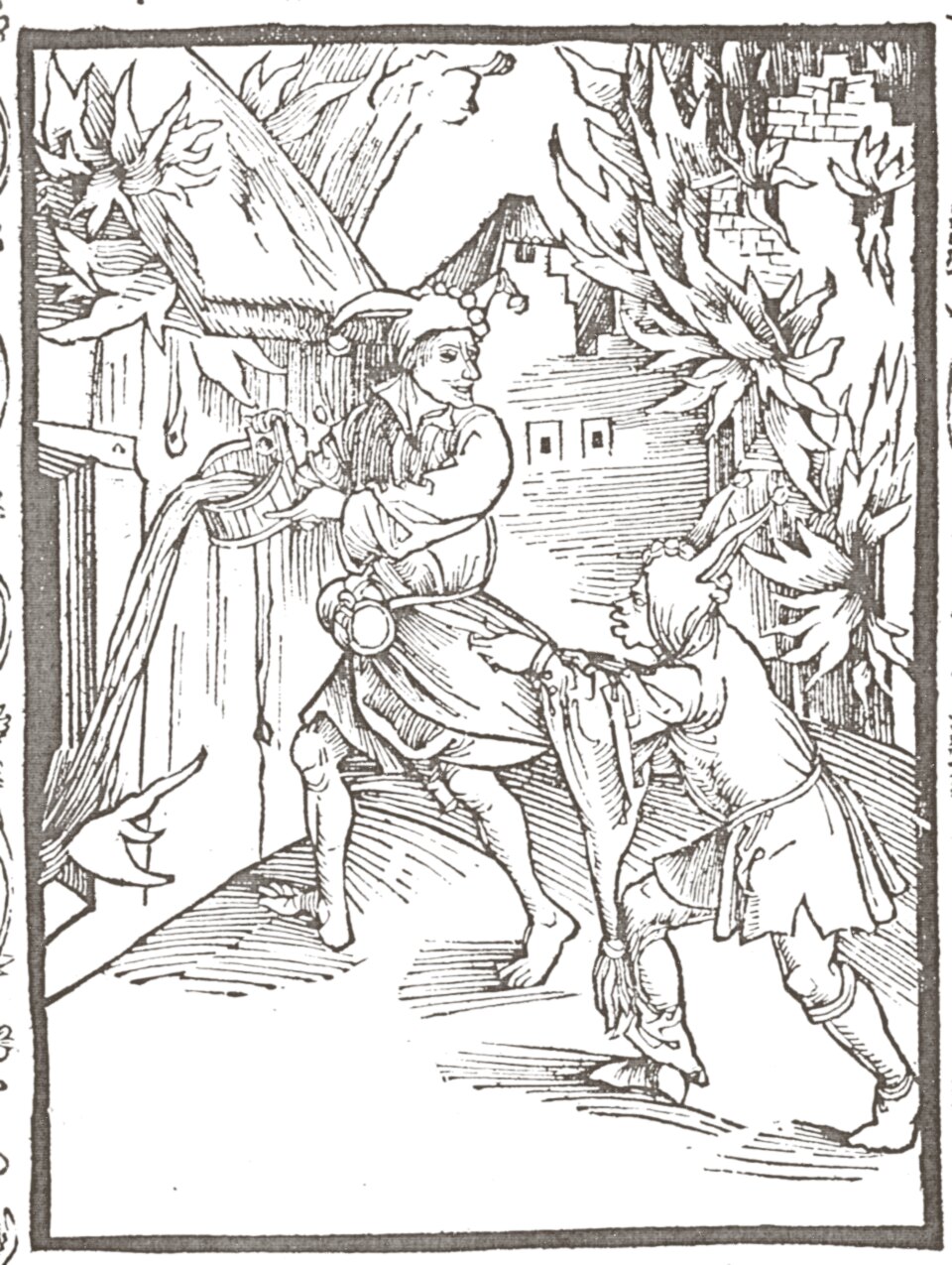
Of folys that forget them selfe and do another mannys besynes leuynge theyr owne vndone
О забвении самого себяOf Forgetting Oneself
Syn selbst vergessen❦
LVIIIО забвении самого себяOf Forgetting Oneself
Кто в хлопотах больших, в трудах,
Чтоб преуспеть в чужих делах
И пользу ближнему добыть,
Тому мартышкой пущей быть,
Коль в собственных делах своих
Не так радив и зорок в них.
Пусть книжку дурней тот читает,
Кто мудр, а о себе не знает.
Кто чинную любовь блюдёт,
С себя пусть начинает счёт.
Теренций учит и меня:
«Себе я ближе всех родня».
Гляди сперва на свой заклад,
А там — как пляшет сват иль брат.
Тот раньше времени падёт,
Кто, не посеяв, людям жнёт.
Кто чистит ближнего кафтан,
А свой обгадил, — тот болван.
Кто у соседа тушит дом,
А над своим — огонь столбом,
И всё его горит дотла, —
Тому своя корысть мала.
Чужую тачку кто везёт,
Себе ж мешает — дурень тот.
Кто делом нагружён чужим,
Себя ж забыл — убыток с ним.
Кто дал склонить себя к тому,
Что срам и вред несёт ему,
Тому не выйти из тенёт:
Дурак за полу в плен берёт,
Ум через вред к нему придёт.
Тому всех тяжелей кончина,
Кого все знают до едина,
А сам умрёт, свой век сведя,
Не научась познать себя.
Wer groß arbeyt vnd vngemach
Hat / wie er fürdere froembde sach
Vnd wie eyns andern nutz er schaff
Der ist me dann eyn ander aff
So er nit jnn synr eignen sach
Luogt / das er flissig sy vnd wach
Der narren buechlin billich lysßt
Wer wiß ist / vnd syn selbs vergißt
Dann der geordnete lieb will han
Der sol an jm selbst vohen an
Als ouch Terencius vermant
Ich bin mir aller naehst verwant
Eyn yeder luog vor syner schantz
Ee er sorg / wie ein ander dantz
Der will verderben ee dann zytt
Der jm nit segt / vnd andern schnyt
Vnd wer eyns ander kleidt mit flisß
Süfert / vnd er das syn beschisß
Wer leschen wil eyns andern huß
So jm die flam schlecht oben vß
Vnd brennt das syn jn alle macht
Der hat vff syn nutz wenig acht
Wer fürdern will eyns andern karr
Vnd hindern sich / der ist ein narr
Wer sich mit froemder sach belad
Vnd selbst versumbt / der hab den schad
Wer sich des über redden latt
Dar vß jm spott vnd schad entstat
Der mag die leng sich nit erwoeren
Der narr erwisch jn by dem goeren
Mach wißheyt jnn mit schaden leren
Dem lydt sin dott am hertsten an
Den sunst erkennet yeder man
Vnd er stirbt / vnd syn leben endt
Das er sich selbst hatt erkennt
Within my Shyp of rowme he shall be sure
Whiche for anothers auantage and profyte
Takyth great thought and doth moche payne endure
Vnto his owne charge takynge no respyte
But settyth it asyde and hath all his delyte
With all his stody hym to enforce and dres:
To care for euery mannys besynes.
Suche hertles folys to them self neglygent
In theyr owne charge slepe contynually
But with open iyen they ar full dylygent
The worke of other with all theyr myght to aply
And for others profyte prouyde they besely.
But whyle these Folys ar glad to take in hande
Anothers charge, theyr owne styll let they stande
Wherfore I am so bolde within my boke
Somwhat to touch these folys mad vsage
That if it fortune them on the same to loke
They may therby perceyue in theyr corage
That labour they ought for their owne auauntage
Most specyally. for that is the degre
And the true order of perfyte charite
For perfyte loue and also charite
Begynneth with hym selfe for to be charitable
And than to other after his degre
Thy owne auauntage is ay moost profytable
The great Phylosophers of maners ferme and stable
And also of wysdome godly and dyuyne
Hath left to vs suche techynge and doctryne
We haue by Therence the same commaundement
The same is wryten also as I fynde
In the holy lawe of the olde testament
And therfore he that oft wyll set his mynde
For others maters with care his thought to blynde
Let hym first se vnto his owne profyte
Lyst some mysfortune hym after sharply byte
Let hym turne his labour to his owne auauntage
And than do for other where as he seeth moste nede
For who that playeth for mony outher gage
And on his felawes cast takyth onely hede
And nat to his owne, suche one shall seldom spede
And is a Fole. So is he that doth ren
To quenche another hous, suffrynge his owne to bren
Suche one of his owne damage hath no fere
And worthy is his losse and hurte to byde
So is he that wyll anothers burthen bere
Or takyth anothers charge at any tyde
Despysynge his owne werke and settynge it asyde
If suche haue losse and after it forthynke
No man shall moche force whether he flete or synke
He is well worthy to haue a folys pype
That goth vnbyddyn to rype anothers corne
And suffreth his owne to stande though it be rype.
And generally all Folys ar worthy scorne
Of what maner byrth so euer they be borne
If they them self put, to losse or damage
Therby to do some other auauntage
Say curyous Fole: say what pleasour thou hast
In others maters thy self to intermyt
Or theyr great charges thus in thy mynde to cast
Thy selfe to socour set thou thy mynde and wyt
Let others maters therfore in quyete syt
On thy owne profyte of all firste set thy mynde
And than (if thou mayst) do somwhat for thy frende
For vtterly that man is moche vnwyse
That thus takyth thought for anothers charge
And doth his owne by neglygence despyse
For suche Folys I forgyd haue this barge
But of the same suche men I clene discharge
That first of his pryuate profyte can take hede
And than helpe a frende and felowe at a nede
Thenuoy of barklay
Ye that take charge, thought and besy cure
For others mysfortune, losse or aduersyte
First of your self I aduyse you to be sure
For this is the order of parfyte charyte
Eche to hym selfe moste louynge ay to be
And next to his frende, but who that doth dispyse.
His owne besynes whiche is in ieopardye
Seynge to anothers forsoth he is vnwyse
Alexander Barclay, The Shyp of Folys of the Worlde, London, 1509 — вольное переложение королевской строфой, с «посланиями» переводчика.a free version in rhyme royal, with the translator’s own envoys.
· LVIII ·