Das NarrenschiffI
Я первым в пляс пущусь: я тьмуБез пользы книг держу в дому,Их не читал и не пойму.
Den vordantz hat man mir gelanDann ich on nutz vil buecher hanDie ich nit lyß / vnd nit verstan
I am the firste fole of all the hole nauyTo kepe the pompe, the helme and eke the sayleFor this is my mynde, this one pleasoure haue IOf bokes to haue grete plenty and aparayleI take no wysdome by them: nor yet auayleNor them preceyue nat: And then I them despyseThus am I a foole and all that sewe that guyse
The foremost rank they've given me,Since I have many useless books,Which I neither read nor understand.
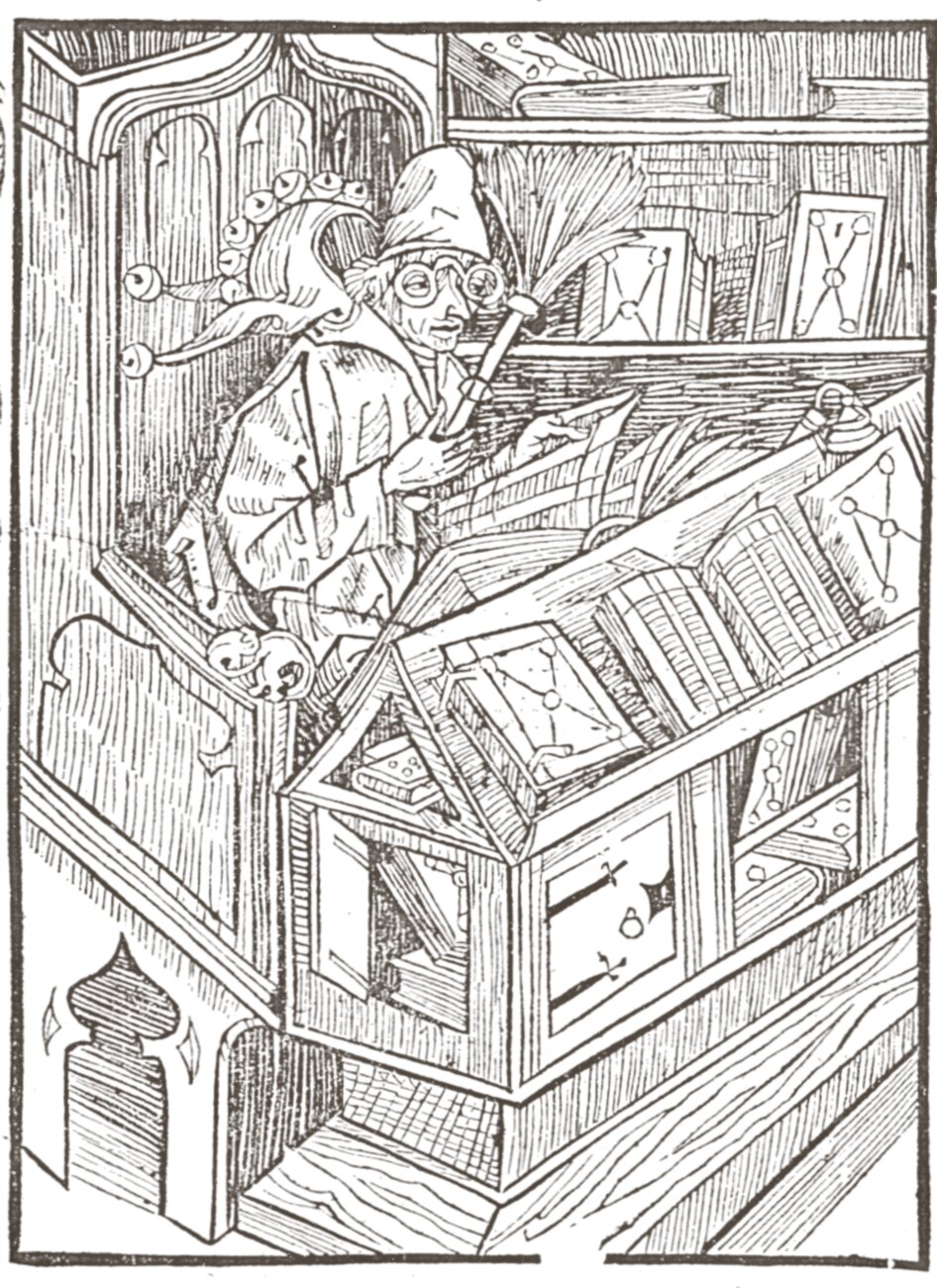
Here begynneth the foles and first inprofytable bokesOf Useless Books
О бесполезных книгахOf Useless Books
Von vnnützen buͤchern❦
IО бесполезных книгахOf Useless Books
Что я на судне впереди —
Тут смысл особый, погляди:
Тому причина есть одна —
Моя опора — книг стена.
Книг у меня — богатый клад,
Хоть слов я в них пойму навряд;
Зато в чести они такой,
Что мух гоняю с них рукой.
Где о науках речь зайдёт,
Скажу: «Их дома — полный свод!»
И тем доволен я вполне,
Что столько книг — и все при мне.
Собрал когда-то Птолемей
Все книги на земле на всей,
В них видя клад ценой безмерной,
Да не имел науки верной
И в них не почерпнул ума.
Вот так и у меня их тьма,
Да я читаю их едва:
Зачем болела б голова?
К чему ученья тяжкий гнёт?
Кто много учит — сумасброд.
Могу и барином я жить,
А кто б учил — тому платить.
Пусть груб умом я и простак,
Но средь учёных, как-никак,
Могу сказать я «ita» — «да»;
Немецкий орден мне всегда
Милей: латынь мне не далась.
Что vinum — то вино у нас,
Что stultus — дурень, gucklus — шут,
Мне ж «doctor domine» поют.
Да уши скрыты; будь не так —
Тварь мельника узнал бы всяк.
Das ich sytz vornan jn dem schyff
Das hat worlich eyn sundern gryff
On vrsach ist das nit gethan
Vff myn libry ich mich verlan
Von buechern hab ich grossen hort
Verstand doch drynn gar wenig wort
Vnd halt sie dennacht jn den eren
Das ich jnn will der fliegen weren
Wo man von künsten reden duot
Sprich ich / do heym hab ichs fast guot
Do mitt loß ich benuegen mich
Das ich vil buecher vor mir sich
Der künig Ptolomeus bstelt
Das er all buecher hett der welt
Vnd hielt das für eyn grossen schatz
Doch hett er nit das recht gesatz
Noch dar vß berichten sich
Ich hab vil buecher ouch des glich
Vnd liß doch gantz wenig dar jnn
War vmb wolt ich brechen myn synn
Vnd mit der ler mich bekümbren fast
Wer vil studiert / würt eyn fantast
Ich mag doch sunst wol syn eyn her
Vnd lonen eym der für mich ler
Ob ich schon hab eyn groben synn
Doch so ich by gelerten byn
So kan ich jta sprechen jo
Des tütschen orden bin ich fro
Dann ich gar wenig kan latin
Ich weiß das vinum heisset wyn
Gucklus eyn gouch / stultus eyn dor
Vnd das ich heyß domine doctor
Die oren sint verborgen mir
Man saeh sunst bald eyns müllers thier
That in this shyp the chefe place I gouerne
By this wyde see with folys wanderynge
The cause is playne, and easy to dyscerne
Styll am I besy bokes assemblynge
For to haue plenty it is a plesaunt thynge
In my conceyt and to haue them ay in honde
But what they mene do I nat vnderstonde
But yet I haue them in great reuerence
And honoure sauynge them from fylth and ordure
By often brusshynge, and moche dylygence
Full goodly bounde in pleasaunt couerture
Of domas, satyn, or els of veluet pure
I kepe them sure ferynge lyst they sholde be lost
For in them is the connynge wherin I me bost.
But if it fortune that any lernyd men
Within my house fall to disputacion
I drawe the curtyns to shewe my bokes then
That they of my cunnynge sholde make probacion
I kepe nat to fall in altercacion
And whyle they comon my bokes I turne and wynde
For all is in them, and no thynge in my mynde.
Tholomeus the riche causyd longe agone
Ouer all the worlde good bokes to be sought
Done was his commaundement anone
These bokes he had and in his stody brought
Whiche passyd all erthly treasoure as he thought
But neuertheles he dyd hym nat aply
Unto theyr doctryne, but lyued unhappely.
Lo in lyke wyse of bokys I haue store
But fewe I rede, and fewer understande
I folowe nat theyr doctryne nor theyr lore
It is ynoughe to bere a boke in hande
It were to moche to be it suche a bande
For to be bounde to loke within the boke
I am content on the fayre couerynge to loke
Why sholde I stody to hurt my wyt therby
Or trouble my mynde with stody excessyue
Sythe many ar whiche stody right besely
And yet therby shall they neuer thryue
The fruyt of wysdom can they nat contryue
And many to stody so moche are inclynde
That utterly they fall out of theyr mynde
Eche is nat lettred that nowe is made a lorde
Nor eche a clerke that hath a benefyce
They are nat all lawyers that plees doth recorde
All that are promotyd are nat fully wyse
On suche chaunce nowe fortune throwys hir dyce
That thoughe one knowe but the yresshe game
Yet wolde he haue a gentyllmannys name
So in lyke wyse I am in suche case
Thoughe I nought can I wolde be callyd wyse
Also I may set another in my place
Whiche may for me my bokes excercyse
Or else I shall ensue the comon gyse
And say concedo to euery argument
Lyst by moche speche my latyn sholde be spent
I am lyke other Clerkes whiche so frowardly them gyde.
That after they ar onys come vnto promocion
They gyue them to plesour theyr stody set asyde.
Theyr Auaryce couerynge with fayned deuocion.
Yet dayly they preche: and haue great derysyon
Against the rude Laymen: and al for Couetyse.
Though theyr owne Conscience be blynded wt that vyce.
But if I durst trouth playnely vtter and expresse.
This is the special cause of this Inconuenyence.
That greatest foles, and fullest of lewdnes
Hauynge least wyt: and symplest Science
Ar fyrst promoted: and haue greatest reuerence
For if one can flater, and bere a hawke on his Fyst
He shalbe made Person of Honyngton or of Clyst.
But he that is in Stody ay ferme and diligent.
And without al fauour prechyth Chrystys lore
Of al the Comontye nowe adayes is sore shent.
And by Estates thretened to Pryson oft therfore.
Thus what auayle is it, to vs to Stody more:
To knowe outher scripture, trouth, wysedom, or vertue
Syns fewe, or none without fauour dare them shewe.
But O noble Doctours, that worthy ar of name:
Consyder our olde faders: note wel theyr diligence:
Ensue ye theyr steppes: obtayne ye such fame,
As they dyd lyuynge: and that by true Prudence.
Within theyr hartys they planted theyr scyence
And nat in plesaunt bokes. But nowe to fewe suche be.
Therefore in this Shyp let them come rowe with me.
The enuoy of alexander barclay translatour exortynge the foles accloyed with this vice to amende theyr foly
Say worthy doctours and Clerkes curious:
What moueth you of Bokes to haue such nomber.
Syns dyuers doctrines throughe way contrarious.
Doth mannys mynde distract and sore encomber.
Alas blynde men awake, out of your slomber
And if ye wyl nedys your bokes multyplye
With diligence endeuer you some to occupye.
That I sit in this ship foremost
A special meaning has in truth,
And is not done without a cause.
For I rely upon my books,
Of which I have a great supply,
But of their contents know no word,
And hold them yet in such respect,
That I will keep them from the flies.
When people speak of knowledge, I say
I have a lot of it at home;
And am content with this alone,
To see a lot of books about.
King Ptolemy, he so contrived,
That he had all books in the world,
And held them for a treasure great.
Still he had not the law of truth,
Nor knew well how to use his books.
So I have many books as well,
And very few of them peruse.
Why should I break my head on them,
And bother myself with lore at all?
Who studies much becomes a guy.
Myself, I'd rather be a man,
And pay people to learn for me.
Although I have a clownish mind,
Yet when I am with learned folk,
I know how to say “ita” for yes.
Of German orders I am proud,
For little Latin do I know.
I know that vinum stands for wine,
Cuculus for gawk, stultus for fool,
That “Domine Doctor” I am called.
If my ears were not hid for me
A miller's beast you'd quickly see.
Alexander Barclay, The Shyp of Folys of the Worlde, London, 1509 — вольное переложение королевской строфой, с «посланиями» переводчика.a free version in rhyme royal, with the translator’s own envoys.
Merrick Whitcomb, A Literary Source-Book of the German Renaissance, Philadelphia, 1899 — построчный перевод.a line-for-line translation.
· I ·