Das NarrenschiffXVI
Тот поделом в нужду впадёт,Кто сласти да питьё лишь чтётИ дружбу с мотами ведёт.
Billich jn künfftig armuot felttWer staets noch schleck vnd füllen steltVnd sich den brassern zuo geselt
That gloton or dronkarde, vyle in goddes sightShall hardly escape the weyght of pouertye.Whiche drynketh and deuoureth both day and nyghtTherin onely settynge all his felycyteHis lothsome lust and his bestyalyteShall brynge vnto destruccion fynallyHis soule, his godes and his wretchyd body.
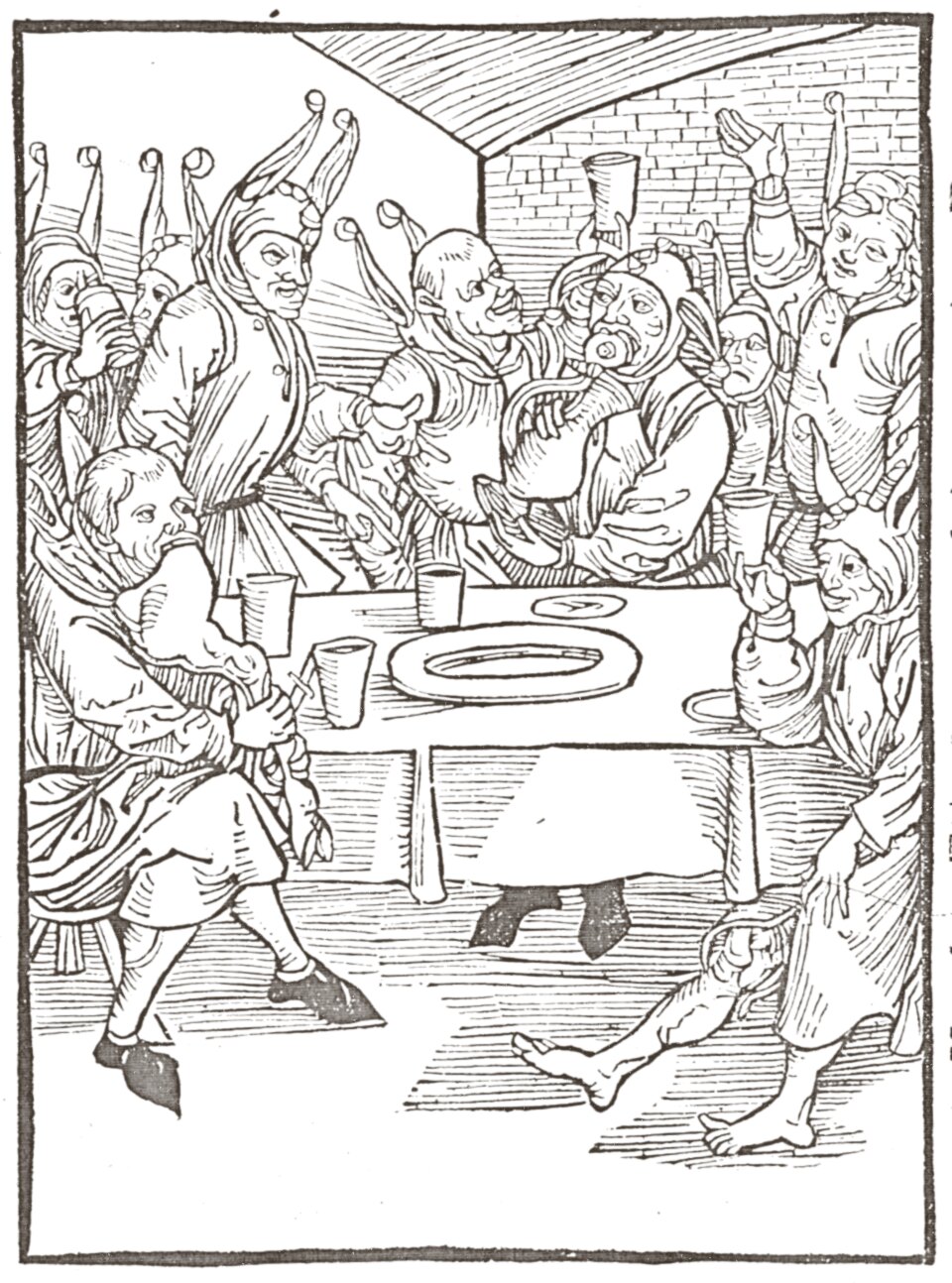
Of glotons and dronkardes
Об обжорстве и пьянствеOf Gluttony and Feasting
Von füllen vnd prassen❦
XVIОб обжорстве и пьянствеOf Gluttony and Feasting
Тот в башмаки глупца обут,
Кто день и ночь несёт свой труд —
Как брюхо, чрево б начинить
И мех с вином собой явить.
Как будто в мир затем рождён,
Чтоб тьму вина извёл бы он
И был как иней круглый год, —
Корабль глупцов такого ждёт.
Он губит ум, и чувств лишён —
Под старость то узнает он,
Как затрясутся лоб и руки;
Свой век урезав, близит муки.
Вино — зловреднейшая сила:
Ума оно всегда лишило
Того, кто в нём искал отрад.
Хмельной на всех плюёт подряд,
Не зная меры и стыда.
От хмеля блуд идёт всегда,
И много зол берёт начало.
Тот мудр, кто пьёт пристойно, мало.
Вина не вынес даже Ной,
Хоть сам нашёл, сажал рукой.
Лот дважды от вина грешил,
Предтечу хмель главы лишил.
Вино и мудреца порой
В колпак обрядит шутовской.
Когда Израиль всласть поел
И с брюхом полным отяжел, —
Пошла игра у них тогда,
Пришла и пляске череда.
Сынам Аароновым Господь
Велел вином не тешить плоть
И всем, что опьяняет нас, —
Да чтит ли клир теперь наказ?
Был Олоферн вином сражён —
И с бородой главы лишён.
Томирис яств, питья дала
И Кира тем превозмогла.
Через вино пал Венадад,
Лишась всего, чем был богат.
Про честь и доблесть забывал
Сам Александр, как пьян бывал,
И часто во хмелю творил,
О чём потом и сам тужил.
Богач пил лихо, как гуляка,
А утром ел в аду, однако.
Не знать бы людям кабалы,
Не будь вина да пьяной мглы.
Кто до вина и жира хват,
Не будет счастлив и богат.
Тому беда, отцу беда,
Раздор и горе навсегда —
Кто, как корова, вечно пьёт
И с каждым здравицу ведёт,
На всё, что поднесут, готов.
Кто пьёт без жажды сто ковшов,
Тот — словно кто средь волн морских
Заснул без чувств, без сил своих.
Так все, кто чтит один кутёж:
Жрут, пьют и в день, и в ночь всё то ж.
По дружбе к ним корчмарь идёт,
Коровы четверть, бок несёт,
Миндаль подаст им, фиги, рис, —
А платят — на льду: знай держись.
Иной бы мудрым стал давно,
Будь мудрость влита в то вино,
Что льют в себя с зарёй и в ночь.
Друг с другом пить они не прочь:
«Я пью к тебе! Тебя взбодрю!
Тебе черёд!» — «Не уступлю,
Держусь, пока не полны оба!»
Вот чем живёт глупцов утроба.
«Раз — к кубку, дважды — в рот!» Добрей
Была б верёвка вкруг их шей
И лучше, чем попойки эти.
То глупость — худшая на свете;
Её Сенека зрел заране
И потому сказал в писанье,
Что пьяным воздадут почёт
Щедрей, чем трезвым, в некий год,
И станет всякий тем хвалиться,
Что смог до одури напиться.
Причту и пивных питухов:
Один на бочку весь готов,
И так нальются всем нутром,
Что дверь сшибай им, как бревном.
Глупцу хлебать — так целый чан,
Мудрец — умеренно, не пьян,
И тем целей, сильней во всём,
Чем тот, кто в глотку льёт ведром.
Вино на входе — мягче нет,
Да жалит, как змея, вослед
И разливает в жилах яд,
Как василиск, зловредный гад.
Der duot eym narren an die schuo
Der weder tag noch nacht hat ruow
Wie er den wanst füll / vnd den buch
Vnd mach vß jm selbs eyn wynschluch
Als ob er dar zuo wer geboren
Das durch jn wurd vil wyns verloren
Vnd er wer eyn taeglicher riff
Der gehoert wol jn das narren schiff
Dann er zerstoert vernunfft vnd synn
Das wirt er jn dem altter jnn
Das jm würt schlottern kopff vnd hend
Er kürtzt syn leben vnd syn end
Eyn schaedlich ding ist vmb den wyn
By dem mag nyeman witzig syn
Wer freüd vnd lust dar jnn jm suocht
Eyn drunckner mensch gar nyemans ruocht
Vnd weiß keyn moß noch vnderscheyt /
Vil vnküsch kumbt vß trunckenheyt /
Vil übels ouch dar vß entsprinckt /
Eyn wiser ist / wer syttlich drinckt /
Noe moecht nit liden den wyn
Der jnn doch fand vnd pflantzet jn /
Loth sündt durch win zuor andern fart /
Durch wyn der toüffer koeppfet wart /
Wyn machet vß eym wisen man
Das er die narrenkapp streifft an /
Do Israhel sich füllet woll /
Vnd jnn der buch was me dann vol /
Do fyngen sye zuo spielen an
Vnd muesten do gedantzet han /
Gott gebot den suenen Aaron
Das sie syn soltten wynes on /
Vnd alles das do truncken macht
Des priesterschafft doch wenig acht
Do holofernes truncken wart
Verlor den kopff er / zuo dem bart /
Thamyris riecht zuo spiß vnd tranck
Do sie den künig Cyrum zwank /
Durch wyn lag nyder Bennedab /
Do er verlor noch all syn hab
All ere vnd tugent gar vergaß
Alexander / wann er truncken was /
Vnd dett gar offt jn trunckenheyt
Das jm wart selber darnach leit /
Der rich man tranck als eyn gesell
Vnd aß des morndes jnn der hell /
Der mensch wer fry / keyn knecht gesyn
Wann drunckenheyt nit wer / vnd wyn
Wer wyns vnd feyßt dings flysset sich
Der wirt nit sellig oder rich /
Dem we vnd synem vatter we
Dem würt krieg / vnd vil vnglücks me
Wer staets sich füllet wie eyn kuo
Vnd will eym yeden trincken zuo
Vnd warten / als das man jm bringt /
Dann wer on nott vil wyns vß drinckt
Dem ist glich / als der vff dem mer
Entschlofft / vnd lyt on synn / vnd wer
Als duont die vff den praß hant acht
Schlemmen vnd demmen / tag vnd nacht
Den dreit der wirt noch kuntschafft zuo
Eyn buog vnd vierteyl von eynr kuo
Vnd bringt jnn mandel / figen / riß /
So bezalen sie jn vff dem yß
Vil würden bald vast witzig syn
Wann wißheyt stecket jnn dem wyn
Die jn sich giessen spat vnd fruo
Je eyner drinckt dem ander zuo /
Ich bring dir eyns / ich kützel dich /
Das gbürt dir / der spricht / so wart ich /
Vnd wer mich / biß wir beid sint vol
Do ist den narren yetz mit wol
Eyns vff dem becher / zwey für den mund
Eyn strick an hals wer eym gesundt
Vnd waeger dann sollich füllery
Triben / es ist eyn groß narry
Die Seneca zitlich für sach
Dar vmb er jnn syn buecheren sprach
Das man würd etwan geben mer
Eym druncknen / dann eym nuechtern ere
Vnd man würd wellen geruemet syn
Das eyner druncken wer von wyn
Die biersupper ich dar zuo meyn
Do eyner drinckt eyn tunn alleyn
Vnd werden do by also vol
Man lieff mit eym eyn tür vff wol /
Eyn narr muoß vil gesoffen han
Eyn wiser maeßlich drincken kan
Vnd ist gesünder vil dar mit
Dann / der mit kübeln jn sich schüt
Der wyn ist gar senfft am jngang
Zuo letst sticht er doch wie eyn schlang
Vnd güßt syn gifft durch alles bluot
Glich wie der Basiliscus duot
Within our nauy he nedes shall haue a place.
Whiche without mesure on lothsome glotony
Setteth his pleasure and singuler solace
His stomacke ouerchargynge, vyle and vngodely
And to none other thynge his mynde doth he aply
Saue depest to drynke, suche force nat of theyr soules
But labore in rynsynge pecis cuppis and bowles
The madnes of dronkennes is so immoderate
That greuous sores it ingendreth and sykenes
It causeth often great foly and debate
With soden deth and carefull heuynes
In thynges no difference putteth dronkennes.
It febleth the ioyntis and the body within
Wastynge the brayne makynge the wyt full thyn
It engendreth in the hede infirmyte
Blyndynge the herte wyt and discression
The mynde it demynyssheth, coloure and beaute.
Causynge all myschef, shame and abusyon
It maketh men mad, and in conclusyon
Causeth them lyue without lawe or measure
Suynge after syn defylynge theyr nature
The people that are acloyed with this synne.
On no thynge els theyr myndes wyll aply:
Saue to the wyne and ale stakes to renne
And there as bestes to stryue and drynke auy
Than ar they outher gyuyn to rybawdry
Or els to brawle and fight at euery worde
Thus dronkennes is the chefe cause of discorde
But namely dronkennes and wretchyd glotony
By their excesse and superfluyte
Engendreth the rote of cursed Lechery
With murder, thefte and great enormyte
So bryngeth it many to great aduersyte
And with his furour the worlde so doth it blynde
That many it bryngeth to a shamfull ende
This vyce (alas) good maners doth confounde
And maketh man ouer besy of langage
And hym that in all ryches doth abounde
It ofte in pryson bryngeth and in bondage
It causeth man to his great sorowe and domage
Disclose his secrete and his preuey counsayle
Whiche causeth hym after sore to mourne and wayle
Nought is more lothsome, more vycyous nor vyle
Than he that is subdued to this vyce
His lyfe shortynge his body he doth defyle
Bereuynge his soule the ioy of Paradyse
Howe many Cytees and lordes of great pryce
Hath ben destroyed by dronken glotony
And by his felawe, false loue, or lechery.
The sone of Thomyr had nat ben ouercome
Nor slayne by Cyrus for all his worthynes.
If he hym selfe had gydyd by wysdome
And the vyce auoydyd of blynde dronkennes
The great Alexander taken with this madnes
With his swerde, whan he was dronken slewe
Suche of his frendes as were to hym most trewe
I rede also howe this conquerour myghty
Upon a season played at the Chesse
With one of his knyghtes which wan ynally
Of hym great golde treasoure and rychesse
And hym ouercame, but in a furyousnes
And lade with wyne, this conquerour vp brayde
And to his knyght in wrath these wordes sayde
I haue subdued by strength and by wysdome
All the hole worlde, whiche obeyeth to me
And howe hast thou alone me thus ouercome
And anone commaundyd his knyght hanged to be
Than sayde the knyght by right and equyte
I may apele. syns ye ar thus cruell
Quod Alexander to whome wylt thou apell
Knowest thou any that is gretter than I
Thou shalt be hanged thou spekest treason playne
The knyght sayd sauynge your honour certaynly
I am no traytoure, apele I woll certayne
From dronken Alexander tyll he be sober agayne
His lorde than herynge his desyre sounde to reason
Differryd the iustyce as for that tyme and season
And than after whan this furour was gone
His knyght he pardoned repentynge his blyndenes.
And well consydered that he shulde haue mysdone
If he to deth had hym done in that madnesse
Thus it apereth what great unhappynes
And blyndnes cometh to many a creature
By wyne or ale taken without measure.
Se here the inconuenyence manyfolde
Comynge of dronkennes as I wrytyn fynde.
Some ar so starynge mad that none can them holde
Rorynge and cryeng as men out of their mynde
Some fyghtynge some chydynge, some to other kynde
Nought lyuynge to them selfe: and some dotynge Johnn
Beynge dronke thynketh hym as wyse as Salomon
Some sowe dronke, swaloynge mete without mesure
Some mawdelayne dronke, mournynge lowdly and hye
Some beynge dronke no lenger can endure
Without they gyue them to bawdy rybawdry
Some swereth armys nayles herte and body.
Terynge our lord worse, than the Jowes hym arayed
Some nought can speke, but harkenyth what is sayd.
Some spende all that they haue and more at wast
With reuell and reuell dasshe fyll the cup Joohnn
Some their thryft lesyth with dyce at one cast
Some slepe as slogardes tyll their thryft be gone
Some shewe theyr owne counsell for kepe can they none
Some are Ape dronke full of lawghter and of toyes
Some mery dronke syngynge with wynches and boyes
Some spue, some stacker some vtterly ar lame
Lyeng on the grounde without power to ryse
Some bost them of bawdry ferynge of no shame
Some dumme, and some speketh. ix. wordes at thryse
Some charge theyr bely with wyne in suche wyse
That theyr legges skant can bere vp the body
Here is a sort to drowne a hole nauy.
Barklaye to the folys
Alas mad folys howe longe wyll ye procede
In this beestly lyuynge agayst humayne nature
Cease of your Foly: gyue aduertence and hede
That in eche thynge ought to be had measure
Wyne ne ale hurteth no maner creature
But sharpeth the wyt if it be take in kynde
But if it be nat, than I the ensure
It dulleth the brayne, blyndynge the wyt and mynde
Rede all bokes and thou shalt neuer fynde
That dronkennes and wysdome may togyther be
For where is dronkennes, there madnes is by kynde
Gydynge the hauer to all enormyte
And where as is madnes thou shalt neuer se
Reason ne wysdome take theyr abydynge
In one instant, wherfore lerne this of me
That dronkennes is mortell enmy to cunnynge.
Alexander Barclay, The Shyp of Folys of the Worlde, London, 1509 — вольное переложение королевской строфой, с «посланиями» переводчика.a free version in rhyme royal, with the translator’s own envoys.
· XVI ·